
Look back
What happened first?
Petting, a moving hand, restraint, play, or another trigger can point to different explanations.
Site search
Behavior sequence guide
If your cat licks you and then bites—or bites and then licks—the order does not have one fixed meaning. Look at what happened just before it: Were you petting or playing? Did your cat tense, turn, or try to leave? Stop contact and give them space. If the bite broke the skin, start with wound care. If the pattern is new, getting worse, or linked to touching one area, check the health guide.
Start with observable clues
The order matters less than the interaction around it. Use what you can observe and change, not an emotional label.
Look back
Petting, a moving hand, restraint, play, or another trigger can point to different explanations.
Do first
Keep your hands still, end the interaction, and give your cat a clear way to move away.
Then
Notice tension, tail speed, ear position, gaze, stillness, release, and movement away.
Change guides if
Use wound care for broken skin. Check the health guide for a new, worsening, or touch-specific response.
What happened first?
The lick does not prove that your cat wanted the touch to continue. If their tail sped up, their body became still, their head turned, or they shifted away, the interaction may have crossed their comfort limit.
The lick afterward does not erase the bite or prove that your cat was apologizing. Look back at the seconds before the bite: what you were doing, what changed in your cat’s body, and whether they could leave.
If your cat tracked a moving hand, grabbed, kicked, released, and returned, play or hunting behavior may fit better. Keep hands still, pause, and use a wand or tossable toy only after the interaction has settled.
Four clues that change the answer
A cat approaching you is useful context, but it is not permission for unlimited touch. Notice whether you reached in, continued petting, or followed when your cat shifted away.
A brief nip and a forceful bite need different safety responses. Do not call a light bite harmless: check whether the skin is broken, and start wound care if it is.
Compare the tail, ears, gaze, posture, stillness, and movement before and after the sequence. A change is more useful than one isolated signal.
Being held, cornered, unable to get off your lap, or blocked in a doorway can change the interaction. Clear a way out and see whether your cat chooses distance.
If your cat was purring too
A cat can purr, lick, accept several strokes, and still need the interaction to end. If the tail speeds up, the ears rotate, the head turns toward your hand, the body freezes, or your cat shifts away, pause. The change in the whole body is more useful than the sound alone.
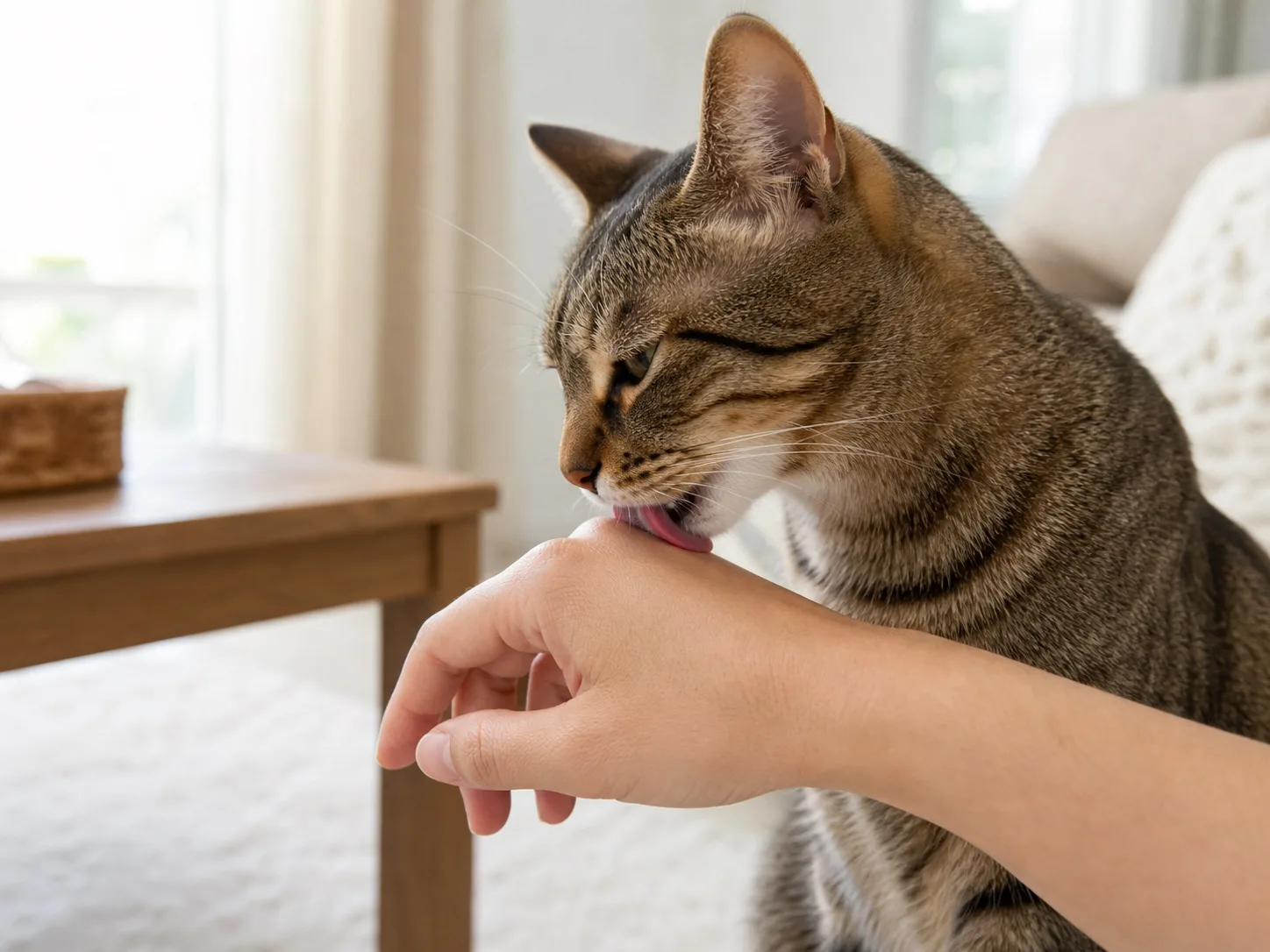
Check the petting guideCats sometimes lick during social contact, but they differ widely in how they interact with people. Licking does not prove that a bite was affectionate, accidental, or an apology.
If this sequence started suddenly or happens whenever you touch one area, stop testing that spot and check the health guide.
What to do in the moment
Your first job is to make the situation quieter and easier to leave. You can sort out petting, play, or another trigger after everyone has space.
Choose the next guide
Leave the behavior explanation for later and start with wound care.
Start wound careUse the touch-tolerance guide to shorten sessions and notice the first stop signal.
Check the petting guideIf the reaction is sudden or linked to touching one area, check whether a health change could be involved.
Check sudden changesUse the matcher to compare petting, play, handling, triggers, and space.
Use the matcherWhat this sequence does not prove
A lick after a bite does not prove an apology. A lick before a bite does not prove betrayal. A gentle bite does not prove affection, and purring does not prove that your cat wants more touch. Those labels may feel like an explanation, but they hide the clues that actually help: context, pressure, body change, and choice.
What about attention-seeking? Treat it as a hypothesis, not a conclusion. If the sequence repeats in the same setup, record what happened immediately before it and what changed afterward; do not assume your cat planned the bite to get a reaction.
Biting-and-licking sources
These sources support the behavior categories, body-language boundaries, and non-punitive response. None establishes one universal meaning for a lick-and-bite sequence.