
This fits if
The situation matches
The bite happened when you lifted, carried, groomed, medicated, trimmed nails, or held your cat in place.
Site search
Cat behavior guide
Being lifted removes control over distance and escape. Some cats tolerate it briefly; others feel unstable, restrained, or physically uncomfortable.

Start by matching the situation
If the bite broke skin, handle the wound first. If not, check whether this sounds like your situation.
This fits if
The bite happened when you lifted, carried, groomed, medicated, trimmed nails, or held your cat in place.
Do first
Put the cat down safely and end the attempt. Do not repeat the same pickup to test whether it happens again.
Then
Use a lower-contact alternative when possible, or break the task into shorter steps with stable support and release before tension rises.
Change course if
Use the health route if pickup tolerance changed suddenly, one body area triggers the bite, or mobility, appetite, grooming, or resting posture changed.

What to look for
Look for bracing, reaching for the ground, stiff posture, or a sudden reaction to one body area.
What to try first
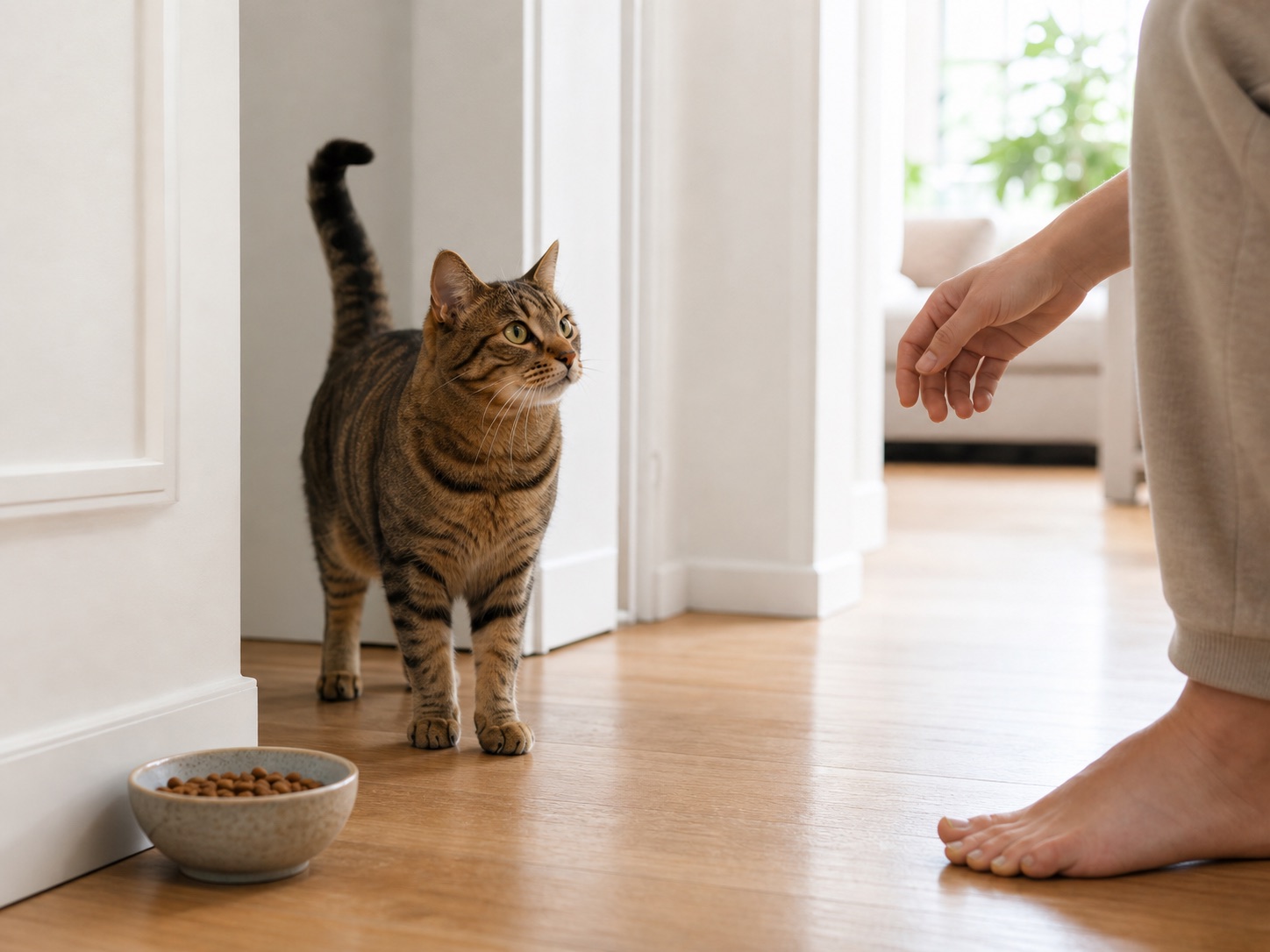
Ask first
Use a lower-contact option when possible: invite, lure, open a carrier, or work on a stable surface.
If you must lift
Hold securely without squeezing. Put the cat down before tension rises instead of waiting for a bite.

For care tasks
Use predictable pauses and rewards. Stop early if stiffness, head turns, or touch sensitivity appears.
When to change course
Use the health route if being picked up was previously tolerated, if one area causes a reaction, or if mobility, appetite, grooming, or resting posture changed.
Why it happens
The fix is not simply to hold the cat more firmly. A firmer hold can make the problem worse if the cat is already worried, unstable, or sore. Start by lowering the amount of restraint and making release predictable.
A cat that can walk away can control distance. A cat in arms has less choice, less balance, and fewer exit options, so a bite may be the fastest way to make the handling stop.
A cat may tolerate a brief supported lift but react when the hold becomes longer, tighter, higher, or less predictable.
Nail trims, grooming, medication, carrier loading, and body checks can combine touch, restraint, unusual smells, and repeated attempts. The cat may react to the whole setup, not only the hands.
If tolerance changed suddenly, one body area triggers the reaction, or jumping, grooming, appetite, or resting posture changed, treat the bite as a possible health signal first.
Real-world patterns
The cat once tolerated being scooped up, but now turns to bite after one or two seconds. The important detail is the change in tolerance, especially if jumping, grooming, or resting posture also changed.
The person keeps trying to finish one more claw, mat, or dose. The cat stiffens, twists, reaches for the ground, then bites because earlier signals did not end the task.
The cat learns that being picked up predicts loss of control. The bite may happen before the carrier appears because the earlier handling pattern already predicts restraint.
A lower-pressure handling plan
For many cats, the better question is not "How do I pick up my cat without being bitten?" It is "Can I complete the task with less lifting, less restraint, and more predictable release?"
A new bite during lifting, grooming, or touch to one area should move you toward a veterinary health check, especially with changes in jumping, grooming, eating, hiding, or resting posture.
Handling-bite sources
These sources support the handling, restraint, care-task, and health-boundary framing. Public examples are scenario patterns, not proof of one cause in an individual cat.