Cat welfare guide

Signs of stress in cats: what changed and what to do next

Possible stress is easier to notice as a change than as a fixed list of symptoms. Compare what you see with your cat’s usual routine: posture, movement, hiding, grooming, play, appetite, litter-box use, sleep, and distance from people or other animals. One signal does not prove stress.

Notice changesReduce pressureDo not diagnose from a checklist

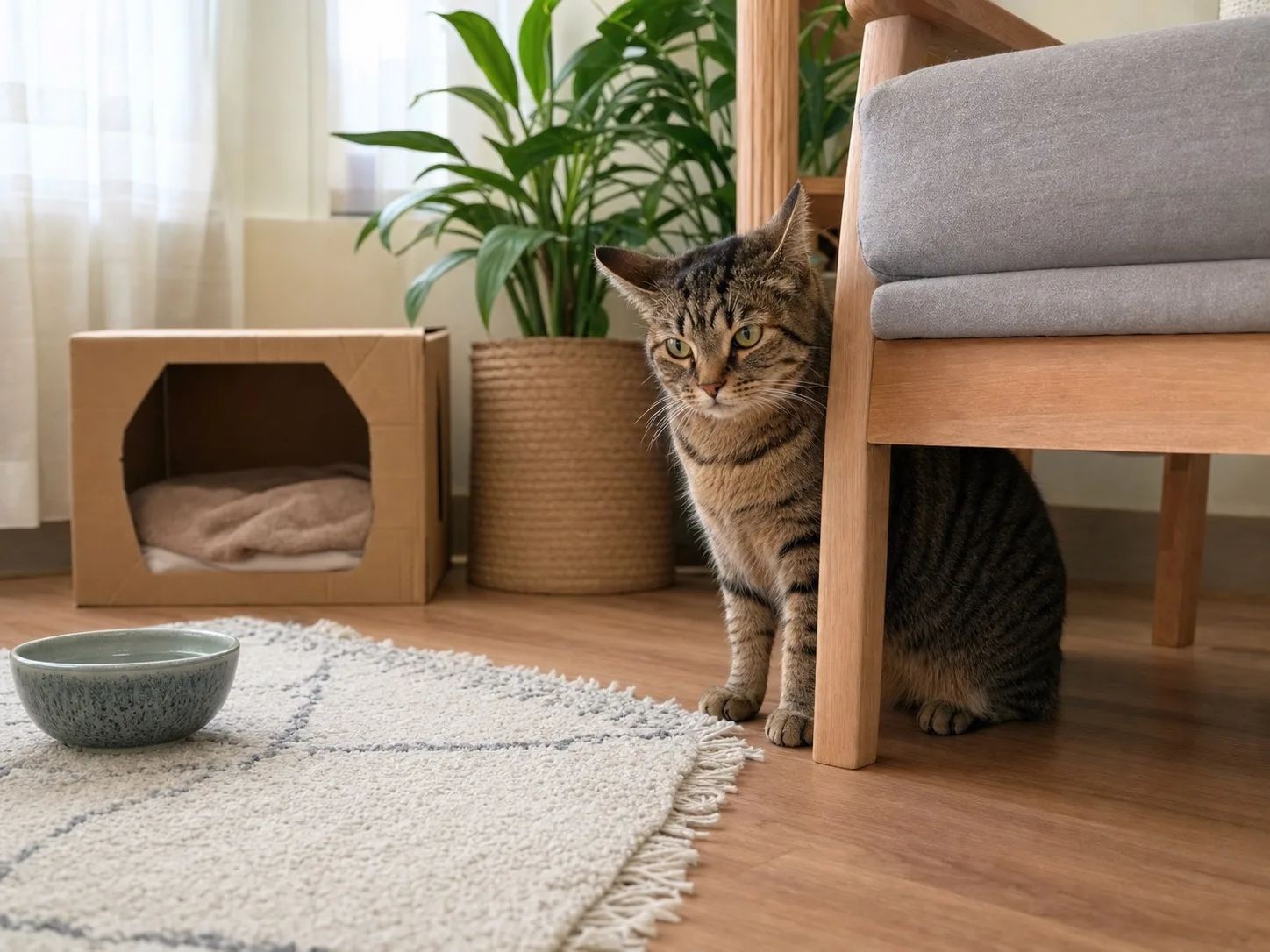
A tabby cat sitting partly behind a chair beside an open hideaway and a bowl

Start with the baseline

Ask what is different for this cat, here and now.

A crouched body, wide pupils, hiding, or a fast-moving tail can appear in a stressful situation, but none has one universal meaning. A cat may crouch before play, pupils change with light, and a hiding place may simply be a favorite bed.

Think about the previous one or two weeks. Has your cat changed where they rest? Do they leave when someone approaches? Are they watching a doorway that used to be neutral? Do they hesitate before using a litter box, feeding area, hallway, or cat door? A small pattern that repeats can be more useful than one dramatic photograph.

Read the whole cat

Compare posture, movement, distance, and context together. The cat body language guide explains why one ear, eye, or tail position is not a diagnosis.

Compare two layers

Body changes and routine changes tell different parts of the story

Look for clusters and direction of change—not a score. Stillness, purring, or walking away only make sense beside the rest of the scene.

Body and movement changes

  • Your cat holds their body lower or tighter, or stays still longer than usual.
  • Your cat scans a doorway, window, person, or another animal repeatedly.
  • They freeze, move away sooner, or take a longer route through the room.
  • They move away from touch sooner or react when an exit is blocked.
  • They hide more often or spend more time in high places than usual.
  • Grooming becomes noticeably more or less frequent than usual.

Daily routine changes

  • Play becomes shorter, less frequent, or disappears.
  • Your cat eats only when a room is quiet or another animal leaves.
  • They wait to use the litter box or avoid a familiar route to it.
  • A usual bed, perch, doorway, or part of the home goes unused.
  • Their sleep schedule or scratching pattern changes, or urine marking, chasing, or conflict appears or increases.
  • One cat starts staring, following, blocking, or displacing another.

These changes do not prove stress. Appetite, elimination, grooming, sleep, or mobility changes may also reflect pain or illness. If the change was abrupt or came with a physical concern, use the sudden behavior and health guide.

Map the environment

Look for pressure around access, exits, and change

The useful question is not whether your cat has an anxious personality. It is whether the setup gives them choice, distance, and predictable access.

Routes and exits

Can your cat reach essentials and leave an interaction without passing or being followed by another cat or person?

Recent changes

Has anything changed recently—a visitor, a move, renovation, a new smell, loud noise, a schedule change, or an outdoor animal?

Shared resources

In a multi-cat home, are food, water, litter boxes, beds, and high places separated—or clustered where one cat can control access?

Repeated pressure points

Does one window, doorway, hallway, or feeding area repeatedly lead to staring, waiting, chasing, or avoidance?

When a visible trigger is involved

If your cat becomes highly aroused after seeing an outside animal or another unreachable trigger, use the redirected arousal guide and create distance before approaching.

What to do first

Choose one or two low-pressure changes

Match the change to what you observed. More interventions at once make it harder to tell what helped.

Make access and choice easier

  • Stop petting, lifting, coaxing, or following when your cat moves away or becomes tense.
  • Keep familiar hiding places open; do not pull your cat out to prove the room is safe.
  • Place food, water, litter boxes, beds, and scratching areas in separate locations, with more than one route to reach them.
  • Add a stable visual barrier where cats repeatedly stare at each other or an outside trigger.
  • Restore predictable times for meals, play, quiet, and sleep.
  • Let greetings and contact happen at the cat’s pace instead of forcing an approach.

Do not add more pressure

Do not yell, spray, scruff, chase, corner, or repeatedly expose your cat to the suspected trigger. Punishment can add pressure and make early signals harder to read.

Respect the exit

Ease off—stop petting, handling, or following when your cat moves away or becomes tense. A choice to leave is useful information.

A seven-day observation map

Record facts, not motive labels

If no urgent or worsening health sign is present, use a short record to see whether the pattern repeats around the same route, resource, person, animal, or time of day.

Write down

  • rooms, perches, and routes used or avoided;
  • when food, water, litter boxes, beds, or high places were difficult to reach;
  • people or animals present near a blocked or avoided route;
  • posture, movement, distance, and available exits;
  • the one environmental change you tried;
  • whether access or recovery became easier afterward.

Useful observation

“Watched the kitchen doorway for two minutes, then waited for the other cat to leave before eating.”

Less useful label

“Jealous,” “angry,” or “getting revenge.” These labels hide the route, timing, and access problem a professional needs to evaluate.

This record can help a veterinarian or qualified behavior professional. It should never delay care when a change is sudden, severe, worsening, or paired with a physical concern.

When to change course

Possible stress can overlap with pain or illness

Contact your veterinarian when a behavior change is sudden, severe, persistent, worsening, or paired with changes in eating, drinking, elimination, breathing, movement, grooming, awareness, or response to touch. Seek urgent veterinary help if your cat strains repeatedly while passing little or no urine, has difficulty breathing, or collapses.

Choose one measurable change

Open a route, separate a resource, or shorten an interaction.

Then watch whether your cat uses the added choice. This page cannot tell whether stress, pain, illness, or several factors are involved. If the pattern persists or another physical change appears, take your observations to your veterinarian.

Cat welfare sources

Guidance used for this page

These sources support the baseline, environmental, intercat, and health-boundary guidance. They do not diagnose an individual cat.

Cats Protection — Spotting signs of cat stress

Subtle behavior and body-language changes, hiding, environmental pressures, and the need to consider health causes.

Cats Protection · Europe / UK

Stress in owned cats: behavioural changes and welfare implications

Behavioral and environmental context for assessing stress-related welfare changes in owned cats.

Journal of Feline Medicine and Surgery / PubMed · Europe / international research

2024 AAFP Intercat Tension Guidelines

Subtle intercat tension, staring, blocking, avoidance, resource distribution, and appropriate veterinary assessment.

Feline Veterinary Medical Association / PMC · North America / international guidance

Feline Lower Urinary Tract Disease

Difficulty urinating, repeated attempts that produce little or no urine, and why suspected urethral obstruction needs immediate veterinary attention.

Cornell Feline Health Center · United States

Emergencies in Cats

Emergency thresholds for difficulty breathing, collapse, and urinary blockage.

VCA Animal Hospitals · North America