
More consistent with mutual play
Roles change, pauses happen, exits stay usable, and both cats choose to return or settle normally afterward.
Site search
Two-cat interaction guide
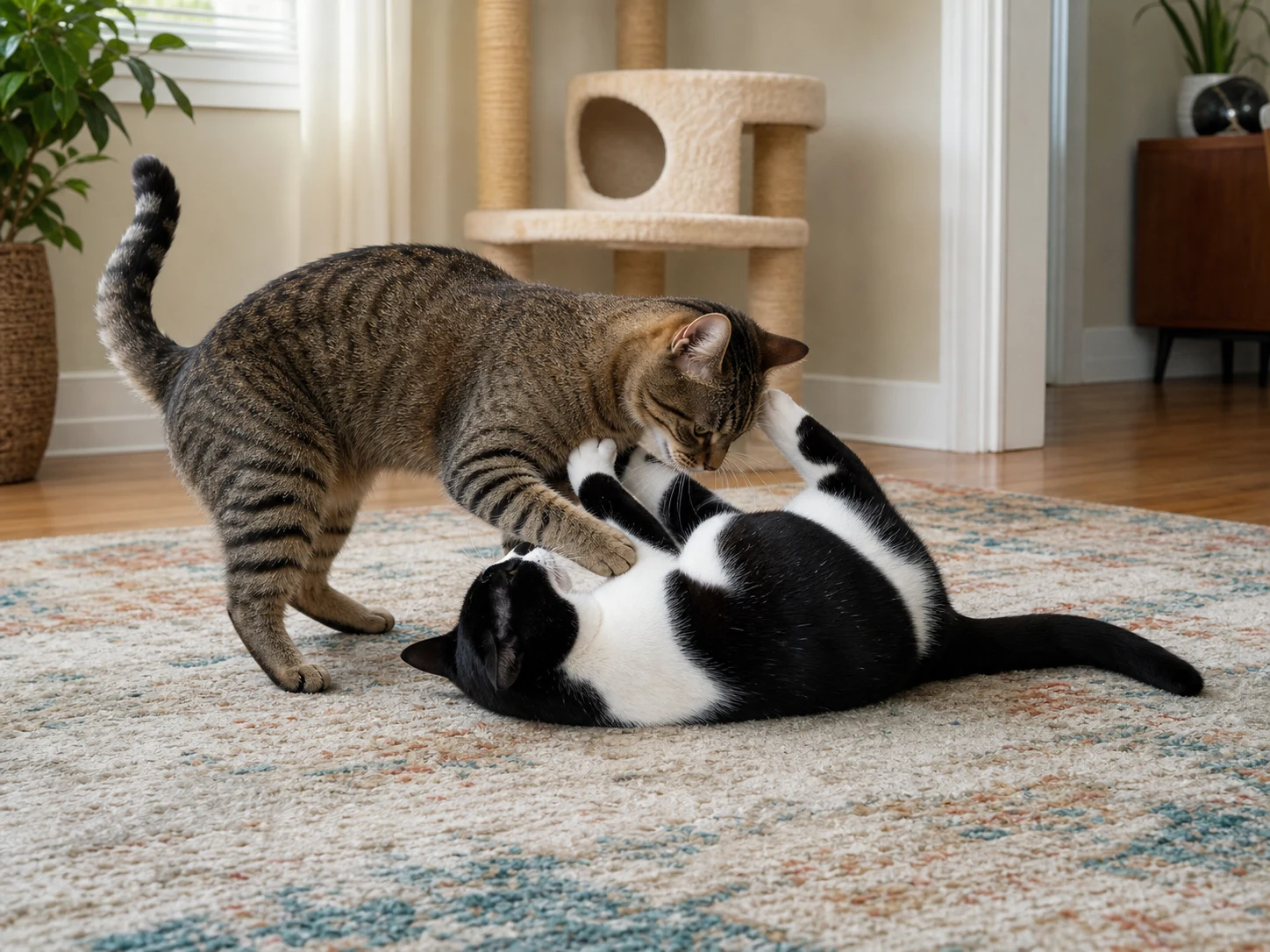
Wrestling, chasing, pouncing, and mouthing can appear in both play and conflict. Watch whether both cats take turns, pause, release, and choose to re-engage; whether either cat can leave; and what happens afterward. Repeated chasing, cornering, blocking, injury, or stopping the other cat from returning to normal routines calls for safe separation.
Quick answer
Roles change, pauses happen, exits stay usable, and both cats choose to return or settle normally afterward.
The interaction contains both loose and tense moments, or one cat wants to stop before the other does.
Pressure is one-sided, an exit is blocked, injury occurs, or one cat cannot resume ordinary routines.
A hiss or swat can end an overexcited play bout. Quiet tension can still matter when one cat stares, blocks, stalks, or displaces the other. Compare the sequence and the relationship outside the obvious encounter.
Five comparisons
Both cats chase, pounce, or wrestle at different points.
One cat leads most of the time, but the other sometimes returns or restarts.
One cat repeatedly pursues, corners, pins, or blocks the other.
The cats break apart, loosen, look away, or reset before choosing to continue.
Contact stops briefly, but one or both cats stay tense and watchful.
There is little release; pursuit restarts whenever the other cat moves.
Either cat can leave without being immediately followed.
An exit exists, but one cat hesitates or takes a longer route.
A doorway, hallway, litter box, food area, perch, or resting place is blocked.
Bodies stay flexible and the interaction is often quiet, although no single signal decides it.
Loose and tense signals alternate, or one hiss ends the contact.
Sustained tension, defensive escape attempts, repeated growling, yowling, or screaming accompany one-sided pressure.
Both cats return to their usual movement, rest, grooming, eating, or use of shared space.
One cat takes longer to settle or keeps more distance for a while.
Hiding, guarding, avoidance, reduced access, appetite change, or repeated vigilance continues.
Between the obvious encounters
One dramatic clip can miss the pressure that shapes daily life. Watch whether both cats can move through the home and reach essentials without waiting, hiding, or being displaced.
Peaceful coexistence can mean passing, resting, and using the home independently without pressure. Sleeping together is not required.
Compare posture, movement, distance, gaze, ears, and tail across both cats. The cat body language guide explains why one signal is not a translation.
If one cat is hiding more, changing routes, grooming differently, or hesitating around food or litter, compare the pattern with the stress-signs guide.
If you are unsure
The goal is distance and separate routes—not punishment, grabbing, or a forced reunion.
Do not put your hands, arms, feet, or a handheld object between cats that are actively fighting. Do not pick up an aroused cat. If a person is bitten, start with the cat-bite wound-care guide.
Do not shout, spray, hit, scruff, corner, or force the cats to face each other again. Discipline and forced contact can add fear and make future encounters harder to interpret.
When play is mutual—but too much
A younger or higher-play-drive cat may keep targeting a quieter, older, or less mobile cat. Give the active cat separate play opportunities with toys, and make sure the other cat can opt out through multiple routes, resting places, high spaces, and separated resources.
One cat wanting to play does not make the interaction mutual if the other cat repeatedly tries to leave. A hiss or swat that ends contact can be communication; the important follow-up is whether the other cat respects the stop. If the same cat repeatedly pursues after the other withdraws, treat the pattern as pressure rather than balanced play.
When to change course
Contact your veterinarian when conflict is new, intense, worsening, changed suddenly, or paired with pain, reduced movement, appetite change, altered grooming, hiding, or litter-box changes. Use safe separation and seek qualified behavior support when injuries occur, one cat cannot access normal resources, or you cannot manage the household safely.
A relationship log
Do not provoke another encounter for the sake of a video or checklist. Record what happens naturally across several days.
Intercat behavior sources
These sources support the reciprocity, tension, separation, environmental, and health-boundary guidance. They cannot label an individual interaction from one photograph or clip.